
-
News
Sara Artal, premiada en el Congreso de la Sociedad Española de Ingeniería Biomédica celebrado en Valencia
18 November, 2026
Esta joven investigadora del grupo BSICoS ha recibido uno de los Premios “José María Ferrero Corral”. Otros tres investigadores presentaron sus trabajos en el CASEIB-2026
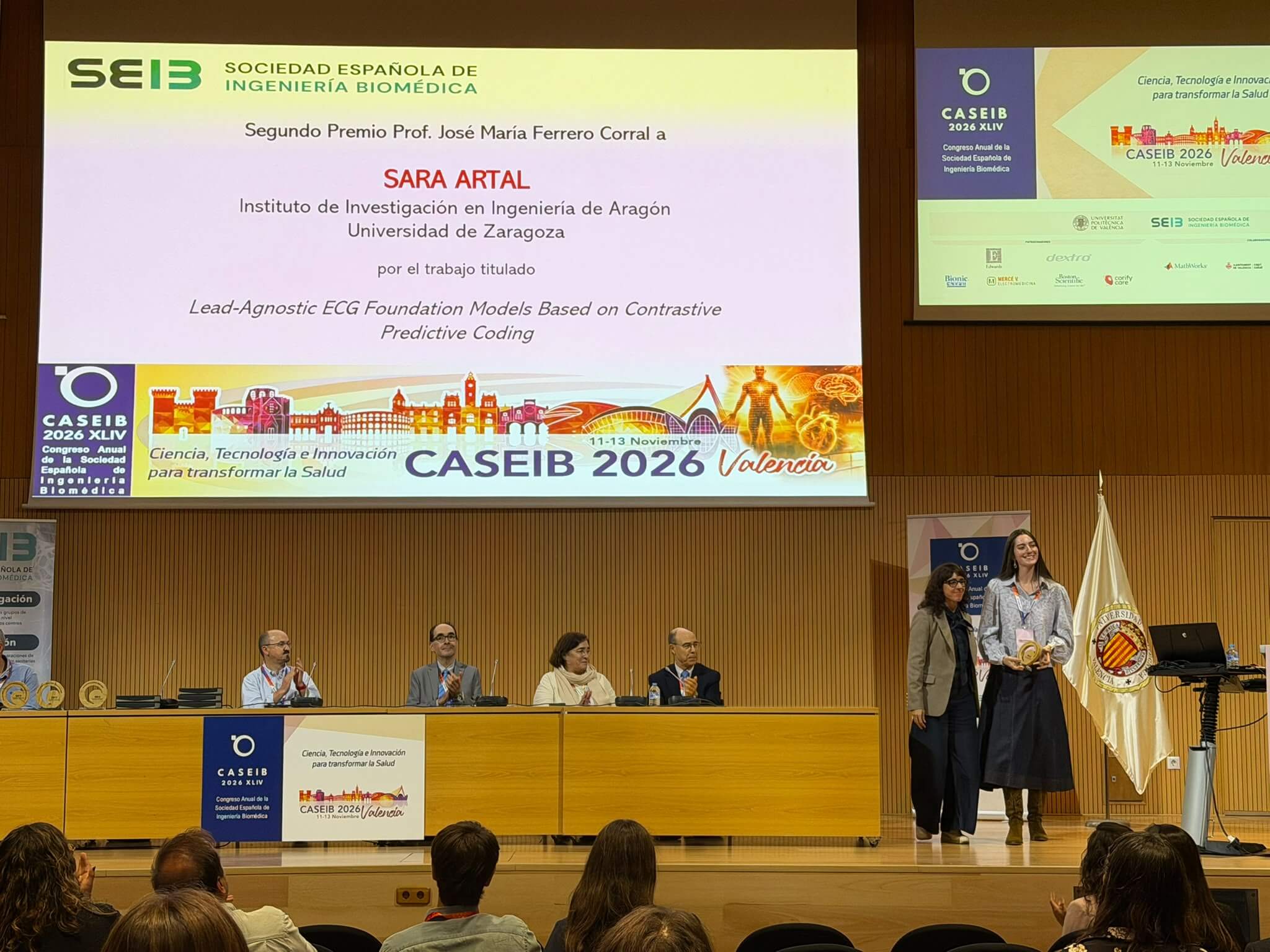
Sara Artal, joven investigadora del grupo BSICoS ha sido premiada en el Congreso Anual de la Sociedad Española de Ingeniería Biomédica (CASEIB) celebrado en Valencia este mes de noviembre. Su trabajo “Modelos fundacionales de ECG independientes de las derivaciones, basados en codificación predictiva contrastiva” ha recibido el segundo premio “José María Ferrero Corral”, dentro de la competición de comunicaciones de estudiantes de máster y doctorado a la que se presentó Sara Artal.
Un total de cuatro investigadores e investigadoras del grupo presentaron sus trabajos en esta cita anual de la Ingeniería Biomédica en España:
Sara Artal: Lead-Agnostic ECG Foundation Models Based on Contrastive Predictive Coding
The electrocardiogram (ECG) is an accessible, non-invasive tool for cardiovascular disease screening. Although deep neural networks have shown strong potential for automated ECG analysis, limited labeled data and severe class imbalance remain major challenges. ECG foundation models (ECG-FMs) address these limitations through self-supervised pretraining on large-scale unlabeled ECG datasets. In this study, we evaluate four lead-agnostic ECG-FMs, based on Contrastive Predictive Coding (CPC), as frozen feature extractors across four downstream tasks with different lead configurations.
In contrast to previous CPC-based approaches, we incorporate learnable lead embeddings, analyze the effect of reducing downstream model depth, and pretrain the models on 15,235,115 public single-lead ECGs. For ECG lead classification, accuracy improved from 0.569 (0.009) to 0.613 (0.010), allowing the downstream model to be reduced from six convolutional (Conv) layers to a single fully connected (FC) layer.
In heartbeat classification, the macro area under the curve increased from 0.847 (0.007) to 0.965 (0.004) while reducing the model from five to one Conv layer. For age and potassium estimation, the downstream architectures were reduced from three Conv layers to a single FC layer, decreasing the mean absolute error from 8.692 (0.241) to 8.049 (0.110) years and from 0.515 (0.011) to 0.498 (0.005) mmol/L, respectively.
The four CPC models consistently outperformed supervised baselines while enabling substantial downstream architecture simplification across ECG tasks and lead configurations. Nonetheless, two architectures stood out as the most promising candidates. These findings demonstrate the effectiveness of CPC-based ECG-FMs in limited-label settings.
Andrea Rucco: P-Wave Remodeling Following Cryoablation and Pulsed-Field Ablation in Patients With Paroxysmal Atrial Fibrillation
P-wave characteristics derived from the surface electrocardiogram (ECG) provide non-invasive markers of atrial electrical activity and may reflect changes in the atrial substrate following atrial fibrillation (AF) ablation. This study aimed to characterize longitudinal changes in P-wave indices after cryoablation (CRY) and pulsed-field ablation (PFA) in patients with paroxysmal AF (pAF).
We prospectively analyzed 12-lead ECG recordings from pAF patients undergoing pulmonary vein isolation with CRY or PFA. ECGs were recorded before ablation and at 3- and 15-month follow-up. P-wave duration (PWD), P-wave terminal force in lead V1 (PTFV1), and P-wave morphological variability (Er) were quantified using signal processing techniques.
87 patients were included (PFA, n=58; CRY, n=29). At 3 months, PWD and PTFV1 were significantly reduced from baseline in the PFA group (129[116;135] vs 121[116;132] ms and 3.7[2.2;4.4] vs 2.3[1.1;3.0] ms·mV, respectively). In the CRY group, PTFV1 was significantly reduced (2.7[1.7;4.5] vs 2.0[1.3;2.7] ms·mV), whereas the reduction in PWD was not significant (p=0.13). Between 3 and 15 months, PWD further decreased in the CRY group (p<0.05), with no significant changes in the PFA group. No significant differences between CRY and PFA were observed for any P-wave index. P-wave morphological variability did not significantly change with either ablation strategy.
CRY and PFA were associated with longitudinal changes in P-wave indices, consistent with modifications of atrial electrical activity following ablation. Despite differences in the temporal evolution of PWD, no significant differences between ablation strategies were observed, suggesting broadly comparable effects on ECG-derived markers of atrial conduction.
Alexia Suárez: Characterization of Music-Evoked Emotional Responses through Heart Rate Variability and Respiratory Signals
Music can evoke different emotional states and influence autonomic nervous system (ANS) activity. This study investigated autonomic responses to emotionally-labeled music, using electrocardiographic (ECG) and respiratory signals. Data were collected from 25 healthy women exposed to eight musical excerpts representing different levels of valence and activation. Heart rate variability (HRV) and respiratory measures were analyzed to identify physiological differences associated with emotional states.
The results showed significant effects of both valence and activation, with frequency-domain HRV measures being particularly sensitive to activation differences, especially under positive valence, while mean heart rate also varied with activation under negative valence.
Under low-activation conditions, significant differences between positive and negative valence were found in mean heart rate, RMSSD, SDNN, LF power, and the LF/HF ratio, suggesting that cardiorespiratory signals can help characterize emotional responses to music and highlighting the importance of considering both valence and activation when studying music-induced emotions; however, the small sample size and female-only population limit the generalizability of these findings.
Maikel Noriega: Evaluación del algoritmo Fast Spectral Correlation para el cribado de fibrilación auricular en registros de balistocardiograma
En este trabajo se evalúa el algoritmo Fast Spectral Correlation (Fast-SC) para el cribado de fibrilación auricular (FA) en segmentos de 30 s de señales balistocardiográficas (BCG). Para ello, se definieron seis características a partir de la distribución de energía cíclica para alimentar un clasificador k-means, evaluado mediante validación cruzada en una cohorte de 46 pacientes que incluye las perturbaciones inherentes al registro ambulatorio.
Fast-SC alcanzó una exactitud del 89 %, sensibilidad del 97 % y especificidad del 84 %, superando a los métodos de Sandelin et al. (60 %, 95 %, 47 %) y Yu et al. (79 %, 74 %, 83 %). Aunque el enfoque basado en Fast-SC evita depender de la morfología del latido BCG, los resultados obtenidos sugieren que la incorporación de estrategias adicionales de preprocesamiento y control de calidad de señal podría mejorar aún más la robustez del sistema.
CASEIB 2026: https://caseib.es/2026/
Premio José María Ferrero Corral: https://caseib.es/2026/premio-jose-maria-ferrero-corral